Turk
Put some Turk in your MVP
The purpose of an MVP is to learn from the market. So think carefully about which features are required for that.
Everyone in startupland knows the standard approach for launching a new product today is to get a Minimum Viable Product (MVP) out into the marketplace and then refine it using rapid iterations informed by usage from actual customers.
That’s an easy concept to embrace, and seems pretty intuitive. The hard part is deciding which features are really part of the required minimum and which features should be deferred until later. The fact is that an entrepreneur is often in love with what he/she thinks are the “magical features” that will differentiate the product, but it may be that it’s better to first prioritize the key features that will prove what an MVP needs to prove, and then the “magic” can be added in later. Because in the short run, the magic can often be mimicked manually.
A famous example is when Pandora launched the original streaming music platform. People were amazed at how Pandora’s “proprietary algorithm” learned their music taste and played music they liked. What users didn’t know is that it was actually interns from UC Berkeley choosing the music, not some secret software. Because what Pandora’s MVP needed to test was whether people would pay for streaming music, and developing the AI-engine wasn’t necessary for the MVP. Once Pandora proved that people loved streaming music, then they raised venture capital and did the software engineering required to create the automated music-choosing algorithms that Pandora became famous for.
This sort of MVP is called a “Mechanical Turk MVP”, and I’ll tell you why:
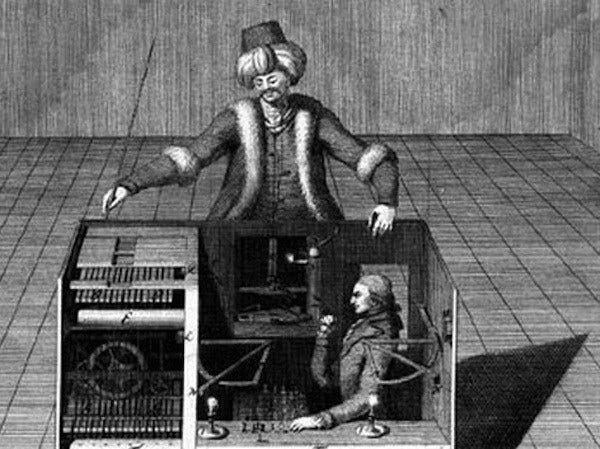
In the 18th century, a guy named Wolfgang von Kempelen created a machine that could play chess. It was a large wooden box with a chessboard and a Turkish-looking “robot” sitting at it (see photo at the top of this post). As a human made moves on the chessboard, the Turk would reach out its mechanical hand and make its move. This amazing device was demonstrated in all the royal courts in Europe, and became known as The Mechanical Turk. Everyone was astonished by the “magic” of a mechanical robot that could play chess. Eventually it was discovered that there was actually a small man hidden inside the box who was controlling the Mechanical Turk. It wasn’t magic, after all. But everyone still loved it.
There are lots of great examples of startups using the “man inside the box” method for getting an MVP off the ground. When CardMunch launched their service of automatically turning business card scans into text entries, at first it was interns doing the transcription. When Wealthfront launched their automated investing platform, the “automation” was just plain old humans sitting at desks. Now a new startup, Magic, is using a mixture of AI and humans to deliver a service that they hope will eventually be all AI. Because that’s how it’s done.
To me, the thing to think about is what features of an MVP are actually required to prove demand for the product and get learnings from. Get those features in first. The magic ones can be added later. After the MVP proves market demand and provides some learnings then we can start spending money on developing the magic. In the meantime, a Mechanical Turk will work just fine.
– — — — –
For more reading on the amazing 18th Century machine, I highly recommend the Tom Standage book, The Turk.